Card Counting Efficacy Thresholds in Free Play and Real Money Blackjack Settings
Olivia Keller · Sep 20, 2026
Card Counting Efficacy Thresholds in Free Play and Real Money Blackjack Settings
Card counting in blackjack relies on tracking the ratio of high to low cards remaining in the shoe, and researchers have long examined how efficacy thresholds shift depending on whether play occurs in free demo environments or real-money platforms. Studies indicate that basic Hi-Lo systems produce measurable edges once the true count reaches +2 or higher in multi-deck games, yet the point at which players decide to increase bets or alter strategy varies markedly between the two formats because financial exposure changes decision parameters.
Core Mechanics of Threshold Identification
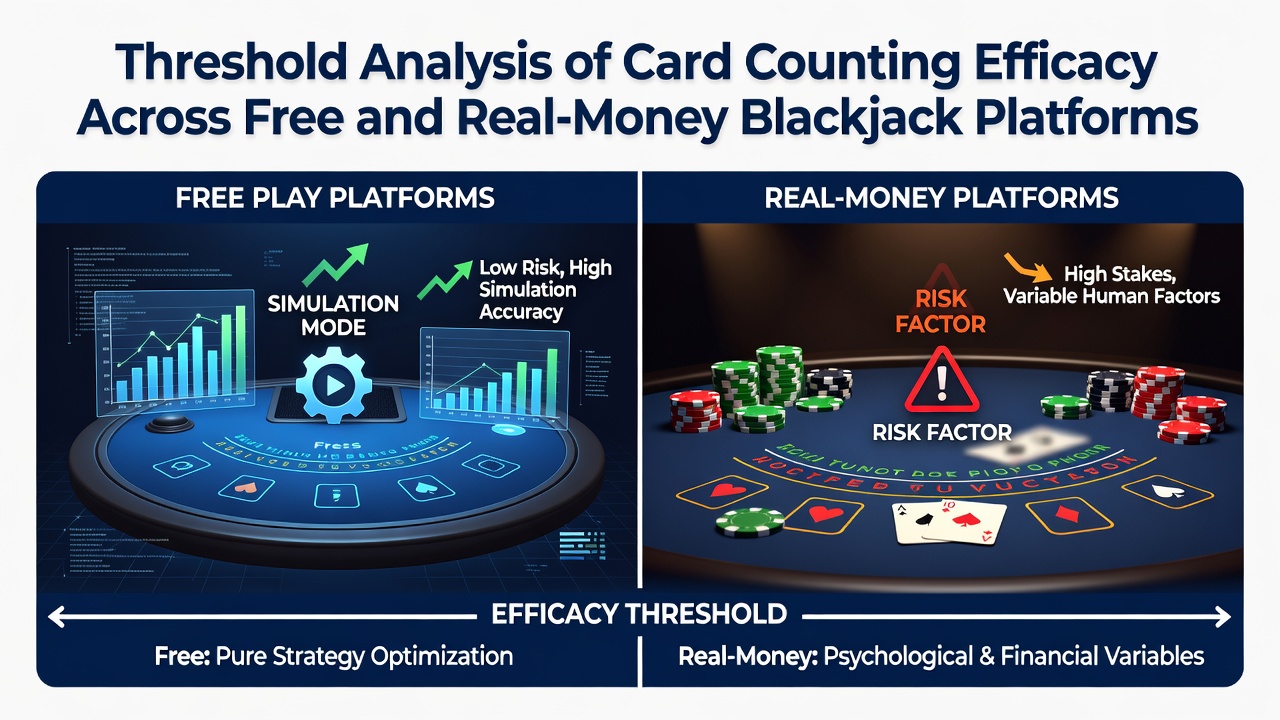
Thresholds emerge from simulation data that models deck composition over thousands of hands, and experts note that free-play platforms often allow unlimited practice sessions where users test count accuracy without bankroll constraints. In contrast, real-money environments impose limits on bet spreads because casinos monitor large wagers, which forces counters to adjust entry points for advantageous counts. Data from multiple deck penetration studies shows that six-deck shoes with 75 percent penetration create reliable positive counts roughly 30 percent of the time, but the decision to act on those counts depends on whether the session carries monetary risk.
Platform Differences in Count Application
Free platforms typically present unlimited credits that reset on demand, and observers find that users therefore experiment with aggressive bet ramps at lower true counts such as +1. Real-money sites enforce table minimums and maximums while also tracking player history, which raises the practical threshold to +3 or +4 before many experienced participants scale their wagers. Simulation software used by academic researchers confirms that the mathematical edge remains identical across formats, yet behavioral adjustments appear once actual currency enters the equation because variance must be weighed against available funds.
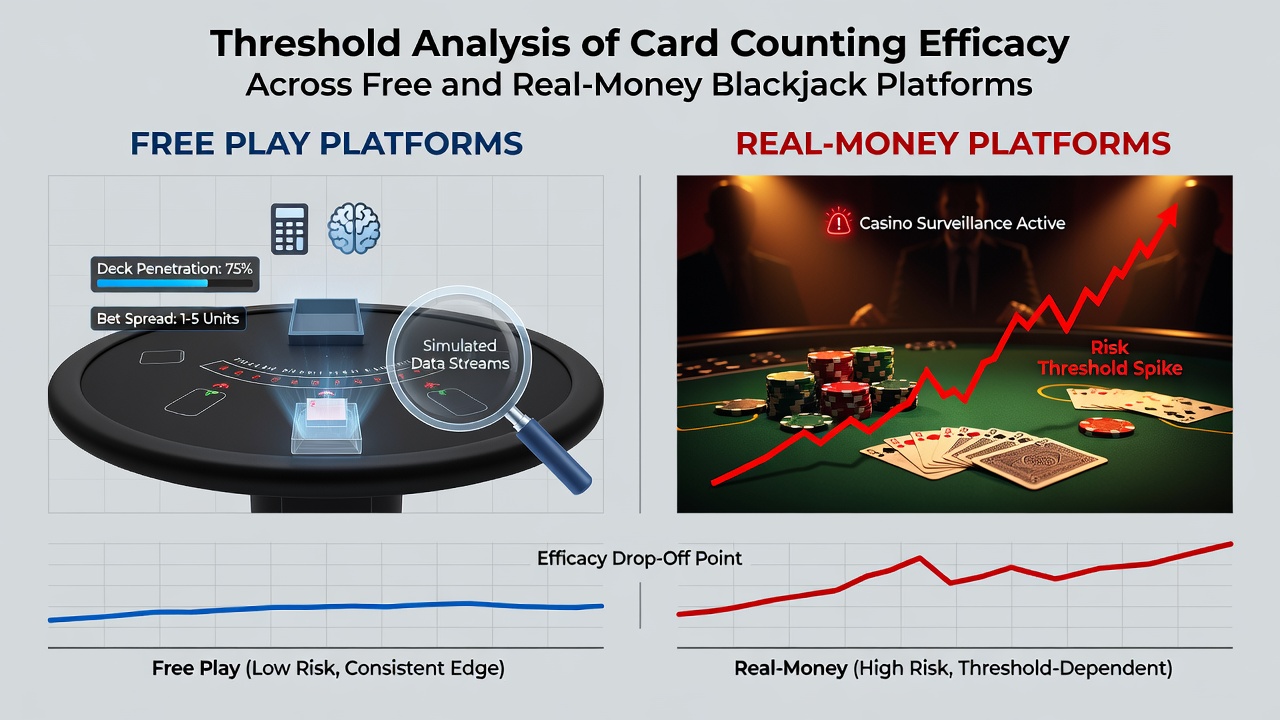
Regulatory records from the Nevada Gaming Control Board document that approved online operators must maintain random number generators equivalent to physical shuffles, which keeps the underlying probabilities consistent. Those same records reveal that operators collect data on bet patterns that can flag unusual activity, prompting counters on real-money platforms to delay bet increases until stronger counts materialize. Free-play versions lack such monitoring, allowing users to practice full Kelly criterion betting at any positive count without consequence.
Impact of Session Length and Deck Depletion
Extended sessions on either platform alter count reliability because each removed card shifts remaining composition, and analysts track how free users often continue play through marginal counts whereas real-money participants tend to exit once the count drops below zero. Research from the Alcohol and Gaming Commission of Ontario indicates that average session length on regulated sites runs shorter than demo play, which compresses the window during which advantageous thresholds can be exploited. Consequently, the effective edge derived from counting narrows in cash games even though the raw probability calculations stay unchanged.
Those studying prolonged rounds note that continuous shuffle machines, when present, eliminate the cumulative effect of card removal and thereby raise the count threshold needed to generate any meaningful advantage. Free platforms rarely implement such devices, which lets users maintain running counts across hundreds of hands and observe gradual edge growth that real-money environments often interrupt.
Conclusion
Threshold analysis ultimately demonstrates that mathematical efficacy remains constant while practical application diverges because of risk exposure, regulatory oversight, and platform design. Free environments support lower entry points for strategy adjustments, whereas real-money settings require stronger counts before bet variation becomes viable. Data collected across both formats continues to inform how players calibrate their approach to deck composition and session constraints.